
Slope Requirements Around Your Foundation
The number one grading rule is simple: the ground must slope away from your foundation on all sides. The minimum recommended slope is 1 inch of fall per foot for the first 6 feet from the house, which translates to a 6 inch drop over that distance. In the Fraser Valley, where clay soil and high rainfall create more hydrostatic pressure against foundations than drier climates, we prefer to see at least 8 to 10 inches of fall in that first 6 feet whenever site conditions allow it.
We check grading with a laser level during every Abbotsford drainage inspection. You would be surprised how many homes have areas where the ground actually slopes toward the foundation. This happens over time as soil settles, garden beds are built up against the house, or downspout splash pads redirect water incorrectly.
Swales and Surface Flow Paths
A swale is a shallow, broad channel that directs surface water across a property without creating erosion. Swales work by creating a gentle low point in the landscape that water follows by gravity. In Abbotsford, we use swales to move water from the back of a house to the side yard and out to the street, or to direct water toward a catch basin or dry well. The advantage of a swale over a pipe is that it handles large volumes of surface water during intense rain events without any mechanical components to fail.
Swales should have a gentle side slope, no steeper than 3 to 1, and a minimum longitudinal slope of 1 percent to keep water moving. They can be grassed, lined with river rock, or planted with moisture tolerant species depending on the aesthetic you want.
Equipment and Process
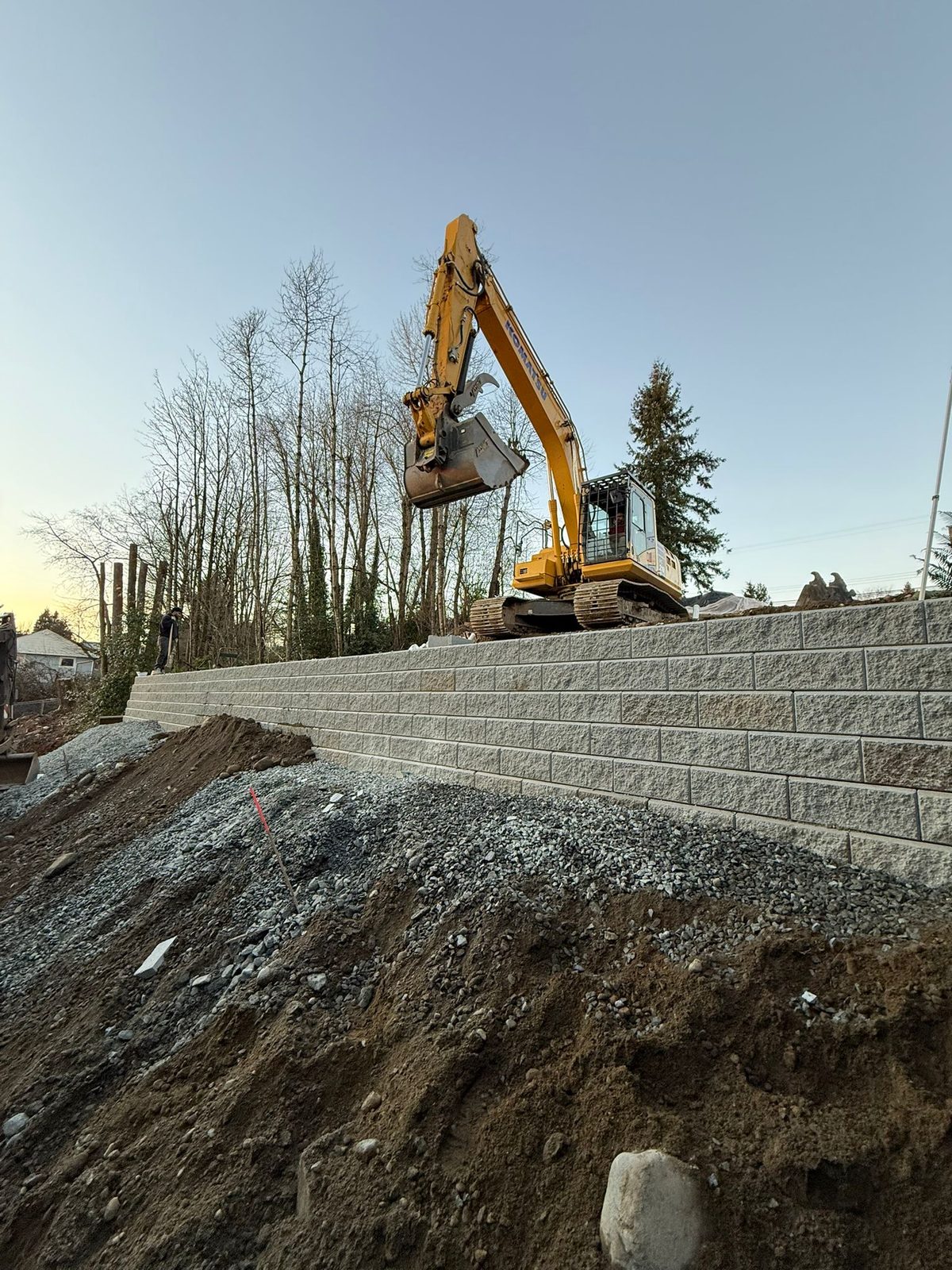
For residential grading projects in Abbotsford, we typically use a compact excavator or skid steer to move material, and a laser level to establish grades. The process starts with identifying the high point (usually the house foundation) and the discharge point (property line, storm drain, or dry well). We then establish a consistent slope between the two, filling low spots and cutting high spots as needed. After rough grading, we compact the subgrade with a plate compactor, spread 4 to 6 inches of quality topsoil, and fine grade to the finished surface.
Common Grading Mistakes
The most common mistake is adding soil against the house without maintaining the required clearance between soil level and the siding or cladding. The BC Building Code requires a minimum of 200 millimetres (about 8 inches) between finish grade and the bottom of the exterior cladding to prevent moisture damage. Building up soil to improve slope without respecting this clearance creates a new problem while solving the old one.
Another frequent error is grading toward a fence line with no outlet. Water that flows to the property line needs somewhere to go. If it pools against a fence or, worse, against a neighbour's property, you have created a drainage conflict. We always plan the full flow path from foundation to discharge before we move any dirt.
Sources & References
- BC Building Code Grading and Drainage Requirements — Province of British Columbia
- Site Grading Standards for Residential Construction — American Society of Civil Engineers
- Stormwater Runoff Grading Guidance — US Environmental Protection Agency