
Why Your Yard Holds Water
Three factors cause standing water on Fraser Valley properties, and most yards have at least two of them working together. The first is clay soil. Abbotsford sits on heavy glacial clay that absorbs water extremely slowly. During sustained rain, the top few inches become saturated and water has nowhere to go. The second is poor grading. Many homes in the region were graded during construction with minimal topsoil, and over time the ground settles, creating low spots that trap water. The third is compaction. Foot traffic, vehicle parking on grass, and heavy equipment during construction compress the soil until it becomes nearly impervious.
Solution 1: Regrading the Yard
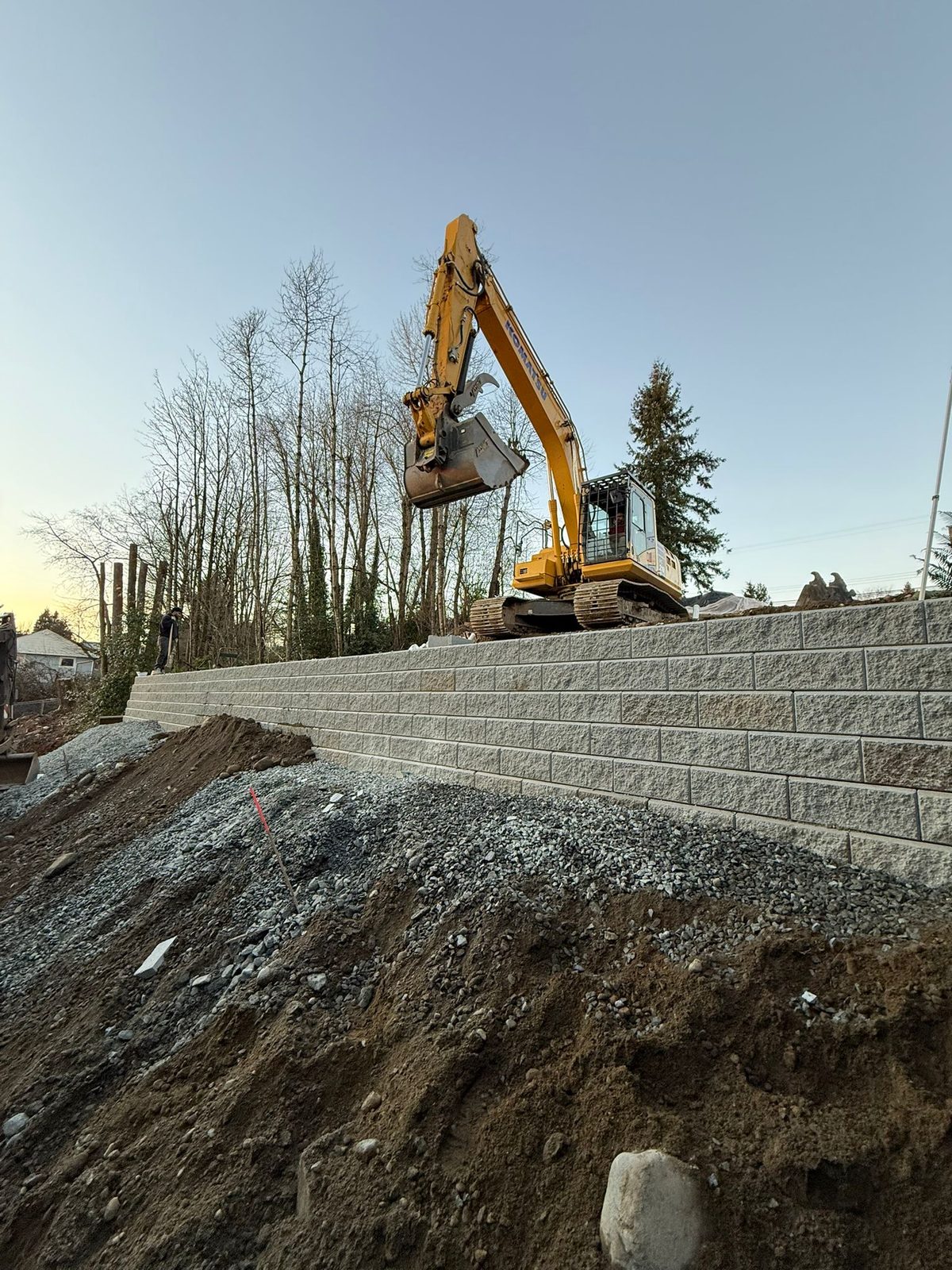
If your standing water problem is caused by low spots or grading that directs water toward your house instead of away from it, regrading is the most direct fix. We bring in a compact excavator, reshape the surface to create a consistent slope away from the foundation (a minimum of 1 inch of fall per foot for the first 6 feet), and reestablish proper surface flow paths. Regrading alone costs between $1,500 and $5,000 for a typical Abbotsford residential lot, depending on how much material needs to be moved.
Solution 2: French Drains and Catch Basins
When regrading alone cannot solve the problem, such as on flat lots where there is no natural slope to work with, we install French drains, catch basins, or a combination of both. A French drain intercepts subsurface water and carries it to a discharge point. Catch basins collect surface runoff at specific low spots. On many Abbotsford properties, especially those in the Sumas Prairie and Matsqui flats, we combine both systems into a single network that handles water from every direction.
Solution 3: Dry Wells for Flat Properties
A dry well is a large underground chamber filled with gravel or a prefabricated storage unit that collects water and allows it to slowly percolate into the surrounding soil. Dry wells are useful on flat properties where there is no slope to daylight a drain pipe to the surface. The water collects in the well and disperses gradually over 24 to 48 hours. Sizing is critical: a dry well that is too small for the volume of water it receives will overflow and defeat the purpose. In Fraser Valley clay, we typically oversize by 50 percent to account for slow percolation rates.
DIY vs Professional Installation
Simple regrading of a small area and shallow surface drainage is manageable as a weekend project. But if your standing water involves foundation proximity, subsurface water, or more than a couple hundred square feet, hire a professional. The risk of redirecting water toward your foundation or a neighbour's property creates liability. We have repaired more than a few DIY drainage projects in Abbotsford where the homeowner accidentally made the problem worse by sending water under the house instead of away from it.
| Solution | Best for | Typical cost | Limitations |
|---|---|---|---|
| Regrading | Low spots, slope toward house | $1,500 to $5,000 | Needs discharge path |
| French drain | Subsurface water, foundation areas | $25 to $65 per linear foot | Requires slope to daylight |
| Catch basin network | Surface runoff on flat areas | $600 to $1,200 per basin | Doesn't address groundwater |
| Dry well | Flat lots without gravity outlet | $2,000 to $6,000 | Slow percolation in clay |
Sources & References
- Green Infrastructure for Stormwater Management — US Environmental Protection Agency
- Canadian System of Soil Classification — Agriculture and Agri-Food Canada
- Fraser Valley Drainage and Flood Management — Metro Vancouver