
Why Fraser Valley Soil Affects Material Choice
Most of Abbotsford and the surrounding Fraser Valley sits on glacial clay deposits. This soil is dense, sticky when wet, hard when dry, and drains extremely poorly. It expands and contracts with moisture changes, and it creates significantly more hydrostatic pressure behind a retaining wall than sandy or loamy soil would. Any material you choose for a retaining wall here needs to work within a system that accounts for these conditions.
The material itself does not fight the clay directly. That is the job of the drainage system behind the wall. But some materials are better suited to the structural demands, freeze thaw exposure, and construction realities of building in clay than others. Here is how the most common options perform in our conditions.
Allan Block
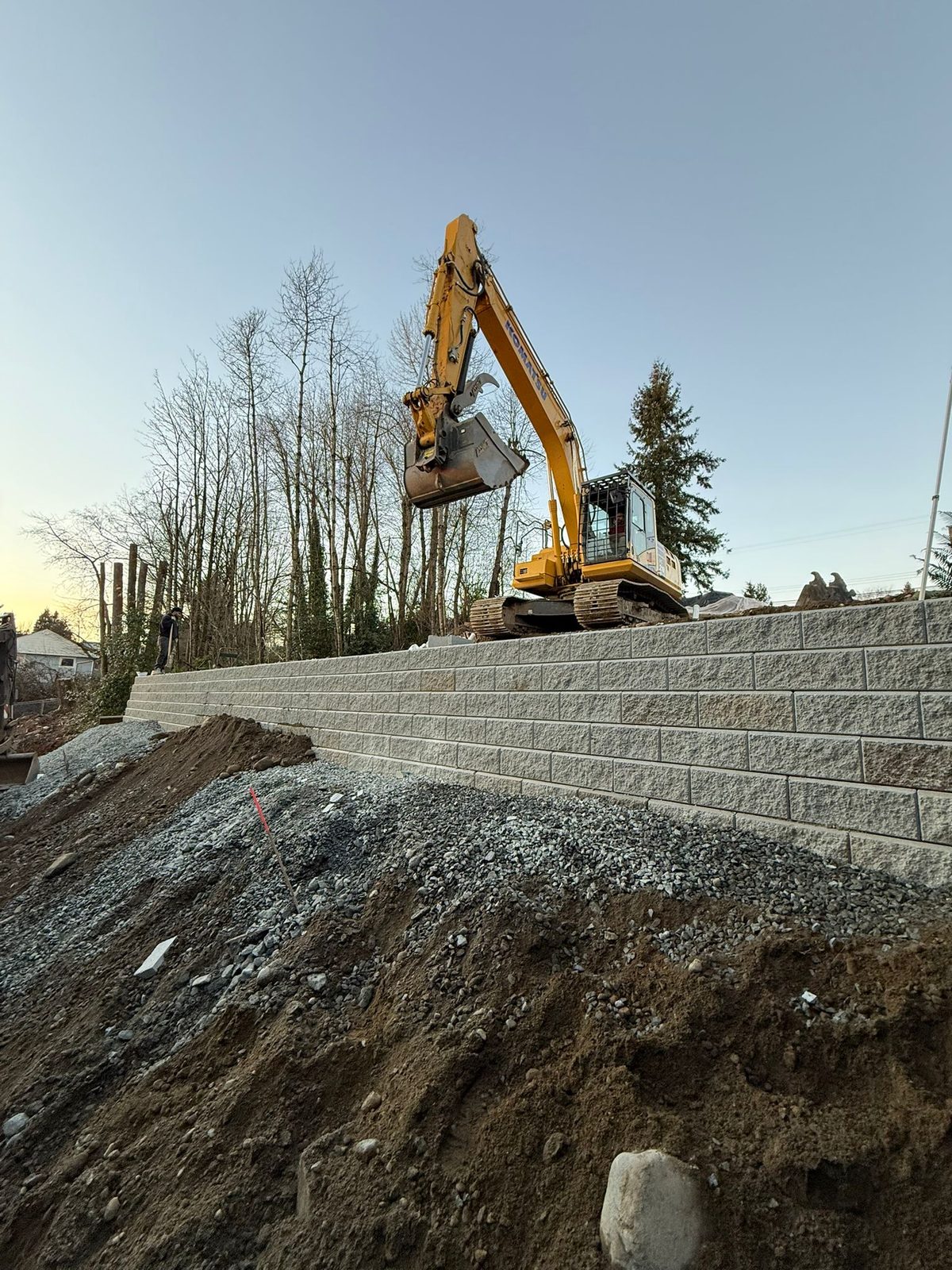
Allan Block is our most frequently installed retaining wall system in Abbotsford. The blocks are manufactured to consistent dimensions with a rear lip that locks each course in place. The system has published engineering tables for walls up to six feet and beyond with geogrid, which makes the engineering and permitting process straightforward. Allan Block handles freeze thaw well because the concrete is manufactured to specific density and absorption standards.
For Fraser Valley clay, Allan Block's biggest practical advantage is construction speed. The uniform block size means we can move quickly through the wall itself, which keeps labour costs down and lets us spend more time on the critical base and drainage work that our soil demands. Most residential walls in Abbotsford's subdivisions are built with Allan Block.
Belgard and Unilock Systems
Belgard and Unilock both manufacture segmental retaining wall systems that compete with Allan Block. They offer a wider range of textures and colour options, which matters if aesthetics are a priority. Belgard's Celtik Wall and Unilock's Pisa series are popular choices we see specified by landscape designers in the Abbotsford area.
From a structural standpoint, all three brands perform similarly in our climate. The differences come down to aesthetic preference, local availability, and price. Belgard and Unilock tend to cost slightly more per block than Allan Block, but the difference is modest. All three systems use similar base, drainage, and geogrid methods, so the critical construction steps are the same regardless of which brand you choose.
Natural Stone and Boulders
Natural stone walls built with basalt, granite, or locally sourced fieldstone offer an aesthetic that manufactured block cannot match. In Abbotsford's clay, natural stone walls need the same drainage system as any block wall, but they require more skill to build because each stone must be fitted individually. The irregular shapes make geogrid integration more complex, which is a consideration for taller walls that need engineering.
Boulder walls are a distinct category. Large boulders (typically 500 to 2,000 pounds each) are stacked using an excavator, with each boulder sitting at a slight backward lean. They work well for walls up to four or five feet and handle our clay soil effectively because their sheer mass resists the lateral pressure. Boulders also give a rugged, natural look that suits many Fraser Valley properties. The main limitation is that boulder walls take up more horizontal space than block walls because of how deep each boulder sits into the slope.
What We Recommend
For most residential retaining walls in Abbotsford, we recommend Allan Block as the default choice. It offers the best balance of cost, structural performance, construction efficiency, and longevity in our conditions. For homeowners who want more visual character, Belgard and Unilock offer premium textures at a modest cost increase. Natural stone and boulders are excellent choices for feature walls, front yard applications, and properties where aesthetics justify the additional cost.
Regardless of material, the drainage and base preparation behind the wall are what determine whether it lasts. We build every wall in the Fraser Valley with the same commitment to gravel backfill, perforated drain pipe, filter fabric, and compacted base, because that is what our soil and climate demand.
| Material | Installed cost / sq ft | Max practical height (residential) | Best use case |
|---|---|---|---|
| Allan Block | $35 to $55 | 6+ ft with geogrid | Default choice for most residential walls |
| Belgard (Celtik Wall) | $40 to $60 | 6+ ft with geogrid | Designer specified walls with texture variety |
| Unilock (Pisa series) | $40 to $60 | 6+ ft with geogrid | Premium segmental block aesthetic |
| Natural stone (basalt, granite) | $60 to $100 | 4 to 6 ft typical | Feature walls, high visibility applications |
| Boulder walls | $40 to $60 per face ft | 4 to 5 ft | Rugged properties, space permitting sites |
Sources & References
- NCMA Design Manual for Segmental Retaining Walls — National Concrete Masonry Association
- Allan Block Engineering Tables and Design Resources — Allan Block Corporation
- ICPI Technical Resources — Segmental Retaining Walls — Interlocking Concrete Pavement Institute