
Why Material Choice Matters in Our Climate
Abbotsford gets over 1,500 millimetres of rain a year, and our winters cycle between freezing and thawing dozens of times each season. That combination is brutal on retaining walls. The material you choose needs to handle constant moisture, resist freeze thaw damage, and work with the heavy clay soil that sits behind every wall in the Fraser Valley.
Allan Block and natural stone are the two options we install most often. Both can last decades when built correctly, but they have very different cost profiles, installation requirements, and visual impact. Understanding those differences will help you make the right call for your property.
Allan Block: Engineered for Performance
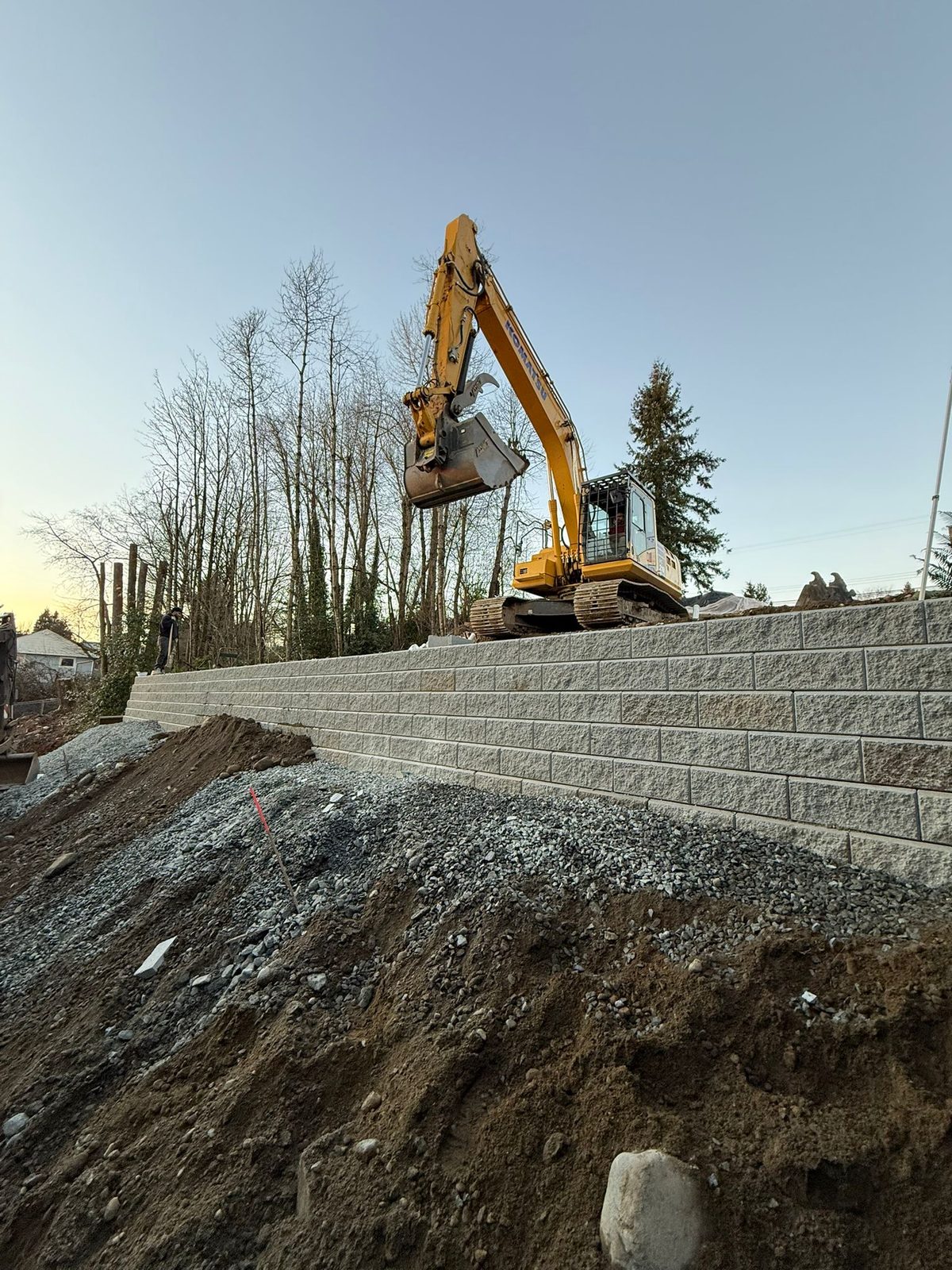
Allan Block is a manufactured concrete retaining wall system with a built in lip that locks each course to the one below it. The blocks are uniform in size and shape, which makes installation faster and more predictable. The system also has well documented engineering tables, so when you need a wall over four feet with geogrid reinforcement, the design process is straightforward.
From a cost standpoint, Allan Block is the more affordable option. The blocks themselves cost less than natural stone, and the uniform shape means less labour time on the wall. For most residential projects in Abbotsford, Allan Block runs about 35 to 55 dollars per square foot fully installed. The textured face gives a clean, consistent look that works well with most home styles.
Natural Stone: Unmatched Character
Natural stone retaining walls have a character that manufactured block simply cannot replicate. Every stone is different, and a well built stone wall becomes a feature of the landscape rather than just a structure. We typically work with basalt, granite, and locally sourced fieldstone for retaining walls in Abbotsford.
The tradeoff is cost and labour. Natural stone is heavier, irregularly shaped, and requires more skilled fitting. A natural stone retaining wall in our area typically runs 60 to 100 dollars per square foot installed. The stones also need careful selection to ensure structural interlock, especially in taller walls. For engineered applications over four feet, natural stone requires more detailed design work than a block system with published engineering data.
When to Choose Each Option
If your primary concern is cost and structural reliability, Allan Block is the practical choice. It is the go to option for long runs of wall, engineered walls with geogrid, and projects where budget matters more than unique aesthetics. Most of the retaining walls we build in Abbotsford subdivisions and new construction are Allan Block.
Choose natural stone when the wall is highly visible and you want it to be a design statement. Front yard walls, entry features, and walls adjacent to outdoor living spaces are all places where natural stone's character justifies the higher price. Some homeowners also combine both: Allan Block for the functional retaining section and a natural stone cap or veneer for the visible face.
| Factor | Allan Block | Natural Stone |
|---|---|---|
| Installed cost per sq ft | $35 to $55 | $60 to $100 |
| Engineering process | Published NCMA and Allan Block tables | Custom design for each wall |
| Install speed | Fast — uniform block dimensions | Slow — each stone fitted individually |
| Typical lifespan | 50+ years | 50 to 100+ years |
| Best use case | Long runs, engineered walls, budget projects | Feature walls, front yards, design statements |
| Geogrid integration | Straightforward with published spacing | More complex due to irregular shapes |
Sources & References
- NCMA Design Manual for Segmental Retaining Walls — National Concrete Masonry Association
- Allan Block Engineering Resources — Allan Block Corporation
- ICPI Technical Resources — Segmental Retaining Walls — Interlocking Concrete Pavement Institute