
When to Consider Terracing
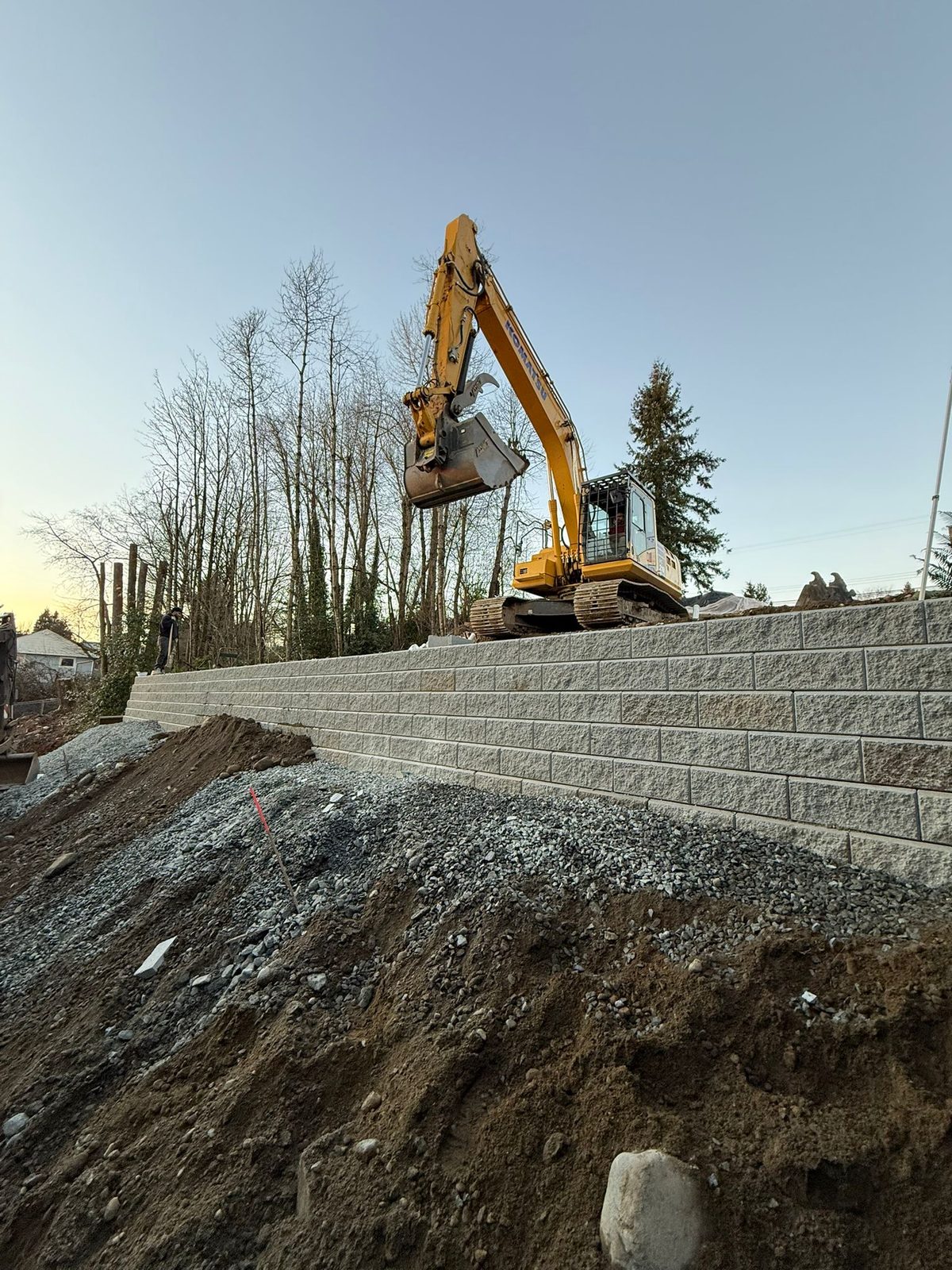
If your slope requires more than four to five feet of total height change, terracing is worth serious consideration. Instead of building one tall wall, you build two or three shorter walls with level planting beds between them. Each wall is shorter, which reduces the soil pressure on any single wall, simplifies the structural requirements, and can eliminate the need for engineering on walls that individually stay under the four foot permit threshold.
In Abbotsford, many properties have slopes of six to ten feet between the house and the back fence. Building a single eight foot wall to handle that grade requires full engineering, geogrid reinforcement, a massive base, and a large drainage system. Terracing that same slope into two four foot walls or three three foot walls is often more practical, more attractive, and in some cases less expensive overall.
Structural Advantages of Terracing
Each wall in a terraced system holds back less soil than a single tall wall. The soil pressure on a retaining wall increases with the square of the wall height, so a wall that is twice as tall does not just hold back twice the weight. It holds back roughly four times the lateral force. By splitting the retained height across multiple walls, you dramatically reduce the forces on each individual structure.
This matters in the Fraser Valley because our clay soil is heavier when saturated, and it stays saturated for long periods during our rain season. Lower forces on each wall mean less chance of failure, less reliance on geogrid, and simpler drainage requirements. Each terraced wall still needs its own drainage system, but those systems are handling less pressure and less water volume individually.
Cost Comparison
Terracing is not automatically cheaper than a single wall. You are building more total wall face, more bases, and more drainage systems. However, you may avoid engineering costs if each individual wall stays under the permit height. For a slope that requires an eight foot single wall, the engineering, geogrid, and oversized base can add 30 to 50 percent to the total cost. Two four foot terraced walls might use more block and gravel but skip those premium structural requirements.
The math depends on your specific slope, the setback distance between walls, and what you plan to do with the space between them. We run the numbers both ways for Abbotsford homeowners and recommend whichever approach gives the best combination of structural performance, aesthetics, and value.
Aesthetic and Functional Benefits
Terraced walls create usable planting beds between each level, turning a steep slope into a series of garden spaces. In Abbotsford's climate, those beds can support everything from ground cover and shrubs to small trees and perennial gardens. The terraces also break up the visual mass of a tall wall, making the grade change feel more natural and less imposing.
From a functional standpoint, the flat areas between terraced walls also slow surface water runoff, giving it more time to soak in or be directed to drainage. On Abbotsford properties that drain toward the house, this stepped approach can meaningfully reduce the volume and speed of water flowing across the yard during heavy rainfall.
| Factor | Single 8 ft wall | Two terraced 4 ft walls |
|---|---|---|
| Engineer stamp required | Yes (always over 4 ft) | Often no (if setback met) |
| Geogrid reinforcement | Required, multiple layers | Minimal or none |
| Base excavation | Deep, wide footprint | Two shallower bases |
| Drainage systems | One large system | Two smaller systems |
| Usable planting space | None above the wall | Level beds between walls |
| Total cost impact | 30 to 50% engineering premium | More block but fewer premium requirements |
Sources & References
- NCMA Design Manual for Segmental Retaining Walls — National Concrete Masonry Association
- Allan Block Engineering — Terraced Wall Design — Allan Block Corporation
- City of Abbotsford — Building Permits & Inspections — City of Abbotsford