
Cost Comparison for Abbotsford Projects
Poured concrete patios in Abbotsford typically cost between 12 and 20 dollars per square foot installed, while paver patios range from 25 to 55 dollars per square foot. On paper, concrete wins on price every time. But that comparison misses the full picture. Concrete patios crack. In the Fraser Valley, they crack a lot. Our clay soil moves seasonally, and freeze thaw cycles put stress on rigid slabs that have no ability to flex. Once a concrete slab cracks, you either live with it, pay to resurface it, or tear it out and start over. Pavers flex as a system because the individual units move independently, which is exactly why they outperform poured concrete in climates like ours.
Durability and Freeze Thaw Performance
This is where the debate tips decisively toward pavers for anyone living in the Fraser Valley. Concrete slabs are rigid and monolithic, so when the ground heaves in winter, the slab cracks. Those cracks allow water in, which freezes and expands, making them worse each season. We see concrete patios in Abbotsford that are badly cracked within five to eight years of being poured.
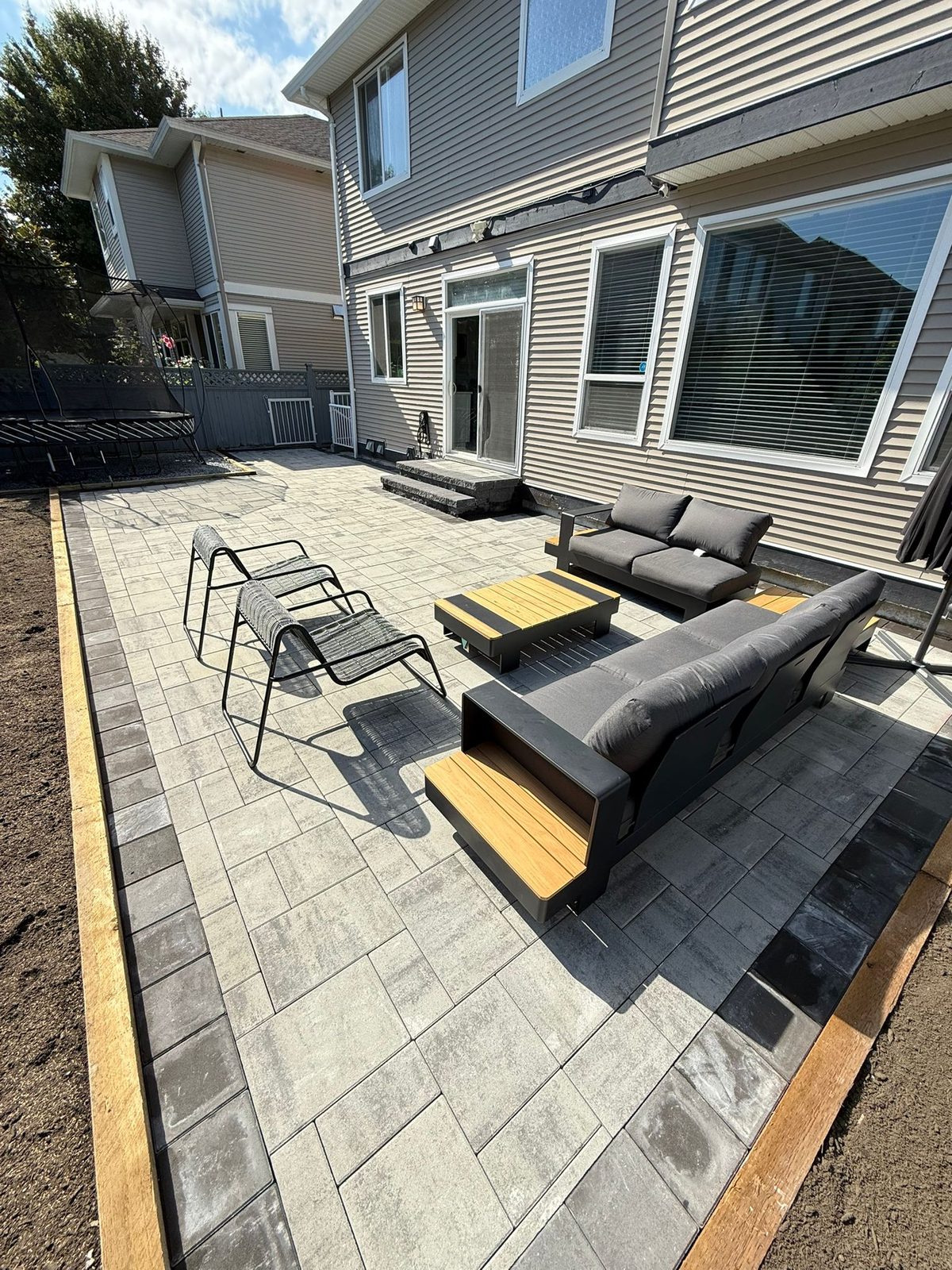
Interlocking pavers handle the same ground movement by shifting slightly as individual units. The bedding sand and polymeric sand joints absorb the stress. If a single paver does crack or settle, you pop it out and replace it for a few dollars. Try doing that with a cracked concrete slab.
Maintenance and Long Term Costs
Concrete requires sealing every two to three years to slow surface deterioration. Even sealed concrete stains from leaf tannins, barbecue grease, and moss, and those stains are difficult to remove without damaging the seal coat. Pavers need a polymeric sand refresh every four to six years and benefit from an annual power wash, but individual stained pavers can be flipped or replaced without touching the rest of the surface. Over a 20 year period, most homeowners in our area spend less maintaining a paver patio than a concrete one when you factor in crack repairs and resurfacing.
Aesthetics and Design Flexibility
Stamped and stained concrete can look impressive when it is new, but the decorative surface wears and fades quickly in our wet climate. Within a few years, most stamped concrete patios in Abbotsford look tired and flat. Pavers hold their colour better, especially premium products with surface treatments from Unilock or Techo Bloc. You also get far more design flexibility with pavers: curves, patterns, inlays, multi colour borders, and contrasting step treads are all straightforward with pavers and extremely difficult with poured concrete.
When Concrete Does Make Sense
We are paver installers, but we will be honest about this. If you are building a utilitarian pad for a garbage enclosure, air conditioning unit, or hot tub base that will be hidden from view, poured concrete is perfectly fine and costs less. It is also the right call for structural slabs like garage floors and house foundations where flexing is not desirable. For a patio that you plan to use, look at, and enjoy for the next 20 years, pavers are the better investment in our climate.
| Criteria | Poured Concrete | Interlocking Pavers |
|---|---|---|
| Installed cost (per sq ft) | $12 to $20 | $25 to $55 |
| Lifespan in Fraser Valley | 8 to 15 years before cracking | 25+ years |
| Freeze and thaw performance | Poor — rigid slab cracks | Excellent — flexes as a system |
| Repair cost per damaged area | $500 to $3,000 (patch or resurface) | $5 to $20 per paver |
| Sealing / maintenance cycle | Reseal every 2 to 3 years | Polymeric sand every 4 to 6 years |
| Design flexibility | Limited (stamping fades) | High — curves, patterns, borders |
| Resale value impact | Neutral to slight negative if cracked | Positive |
| Best for | Utility pads, structural slabs | Patios, walkways, driveways, pool decks |
Sources & References
- ICPI Tech Spec 4 — Structural Design of Interlocking Concrete Pavements for Roads and Parking Lots — Interlocking Concrete Pavement Institute
- Canadian Climate Normals 1981 to 2010 — Abbotsford A Station (freeze and thaw cycle data) — Environment and Climate Change Canada
- CSA A231.2 — Precast Concrete Pavers Standard — CSA Group