
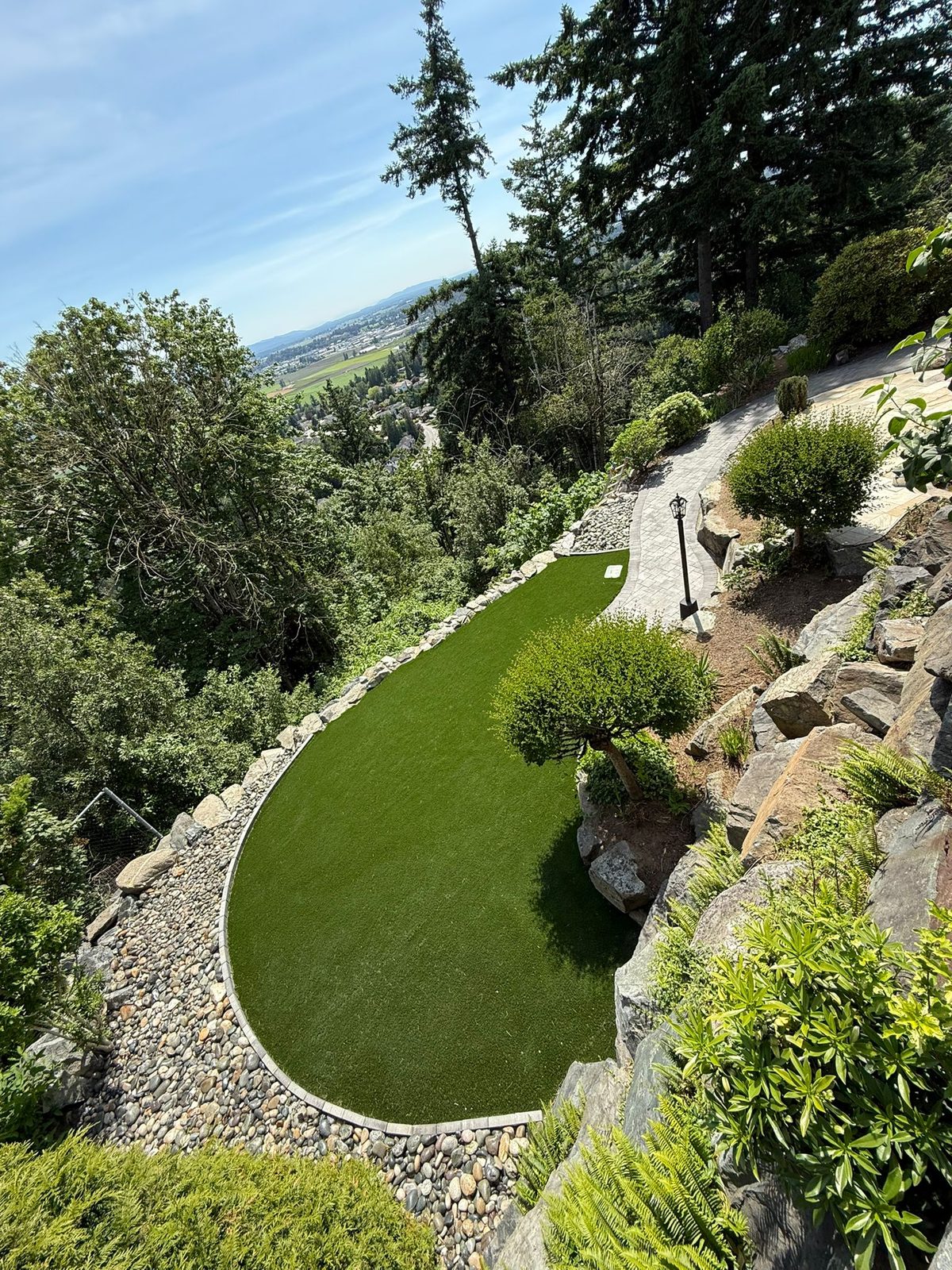

Maintenance: Where the Biggest Difference Shows Up
Natural grass in the Fraser Valley demands constant attention. You are mowing every week from April through October, aerating in spring and fall, fertilizing multiple times per season, and treating for moss that takes over every winter in our damp climate. After 15 years of installing turf in Abbotsford, we can tell you that the maintenance burden is the number one reason homeowners call us.
Artificial turf needs occasional brushing to keep the fibres upright, rinsing to remove dust, and a light infill top up every few years. That is the entire maintenance program. There is no mowing, no edging, no fertilizing, and no fighting moss from November through March. For busy families and homeowners who would rather enjoy their yard than work in it, the time savings are enormous.
Water Savings and Environmental Impact
Abbotsford does not face the same water restrictions as drier parts of BC, but summer watering is still a real cost. A typical 1,000 square foot lawn needs roughly 600 gallons per week during July and August to stay green. Over a 20 year period, that adds up to a significant volume of treated municipal water.
Artificial turf uses zero irrigation water. It also eliminates the need for chemical fertilizers and herbicides, which can leach into the Sumas watershed during heavy rain. The environmental trade off is that turf is a manufactured product with a finite lifespan, and end of life recycling options are still limited in BC. For homeowners who prioritize water conservation and reduced chemical use, synthetic turf is a clear win. For those focused on soil biology and carbon sequestration, natural grass has an edge.
Appearance Through the Seasons
Natural grass in Abbotsford looks its best in late spring and early summer. By August, without consistent watering, it often turns brown and patchy. By January, moss is the dominant ground cover on many lawns. The lush, uniform look that homeowners want is really only achievable for about four months of the year without significant effort.
Quality artificial turf stays green and consistent year round. Modern polyethylene turf includes multiple shades of green and brown thatch fibres that mimic the look of healthy natural grass remarkably well. Visitors often cannot tell the difference from the street. The one area where natural grass wins visually is the soft, slightly irregular texture that only real blades provide.
Upfront Cost vs Long Term Cost
Natural grass is cheaper to install. A full sod installation in Abbotsford typically runs $2 to $4 per square foot. Artificial turf runs $8 to $15 per square foot installed. That upfront gap is significant. However, once you factor in ten or fifteen years of mowing, fertilizing, aerating, moss treatment, and water, the total cost of ownership for natural grass often exceeds artificial turf. The breakeven point usually falls somewhere between year five and year seven.
Which One Is Right for You?
There is no universally correct answer. If you enjoy lawn care, value soil biology, and have the time for weekly maintenance, natural grass is a fine choice. If you want a green, low maintenance yard that looks good twelve months of the year with minimal effort, artificial turf is the better investment. Many of our Abbotsford clients install turf in the front yard and keep a small natural grass play area in the back, which gives them the best of both options.
| Factor | Artificial turf | Natural grass |
|---|---|---|
| Installed cost per sq ft | $8 to $15 | $2 to $4 (sod) |
| Annual water use (1,000 sq ft) | 0 gallons | ~15,000 gallons in summer |
| Weekly maintenance | None | Mowing, edging, treating |
| Lifespan | 15 to 20 years | Indefinite with care |
| Year round appearance | Consistently green | Brown in Aug, mossy Nov to Mar |
| Chemical inputs | None | Fertilizer, herbicide, moss killer |
Sources & References
- Metro Vancouver — Water Conservation — Metro Vancouver
- Synthetic Turf Council — Environmental Benefits — Synthetic Turf Council
- Environment and Climate Change Canada — Climate Data — Government of Canada