
Why Drainage Matters More in the Fraser Valley
Abbotsford receives over 1,500 millimetres of rain per year, with the heaviest rainfall concentrated between October and March. That volume of water has to go somewhere, and if your turf installation does not have a properly engineered drainage system, it pools on the surface, saturates the base, and creates a soggy, unusable yard. We have seen installations done by other companies where the turf floats during heavy storms because the base has no drainage capacity. It is an expensive mistake to fix after the fact.
Proper drainage is not optional in our climate. It is the single most important engineering decision in any turf project.
Perforated Turf Backing: The First Layer of Drainage
All quality artificial turf products are manufactured with a perforated polyurethane or latex backing that allows water to pass through the surface. The perforations are small holes punched at regular intervals across the entire backing. Standard turf drains at a rate of roughly 25 to 30 inches per hour through these perforations, which exceeds any rainfall rate we see in the Fraser Valley.
Some economy turf products have fewer perforations or use a non perforated backing. We do not install these products in Abbotsford because they create surface pooling during even moderate rain events. If the water cannot get through the turf surface, it has nowhere to go.
Base Layer Design: Where the Real Engineering Happens
The base layer beneath the turf is where drainage is truly managed. We excavate to a minimum depth of four to six inches and fill with clean, angular drain rock that compacts firmly but retains void space for water to flow through. On top of the drain rock, we place a layer of crusher dust that provides a smooth, level surface for the turf to sit on while still allowing water to percolate downward.
In Abbotsford yards with heavy clay soil, we also install a geotextile fabric between the native soil and the drain rock base. This prevents clay particles from migrating upward into the base and clogging the drainage voids over time. Without this separation layer, clay contamination can reduce the base's drainage capacity within a few years.
Slope Requirements
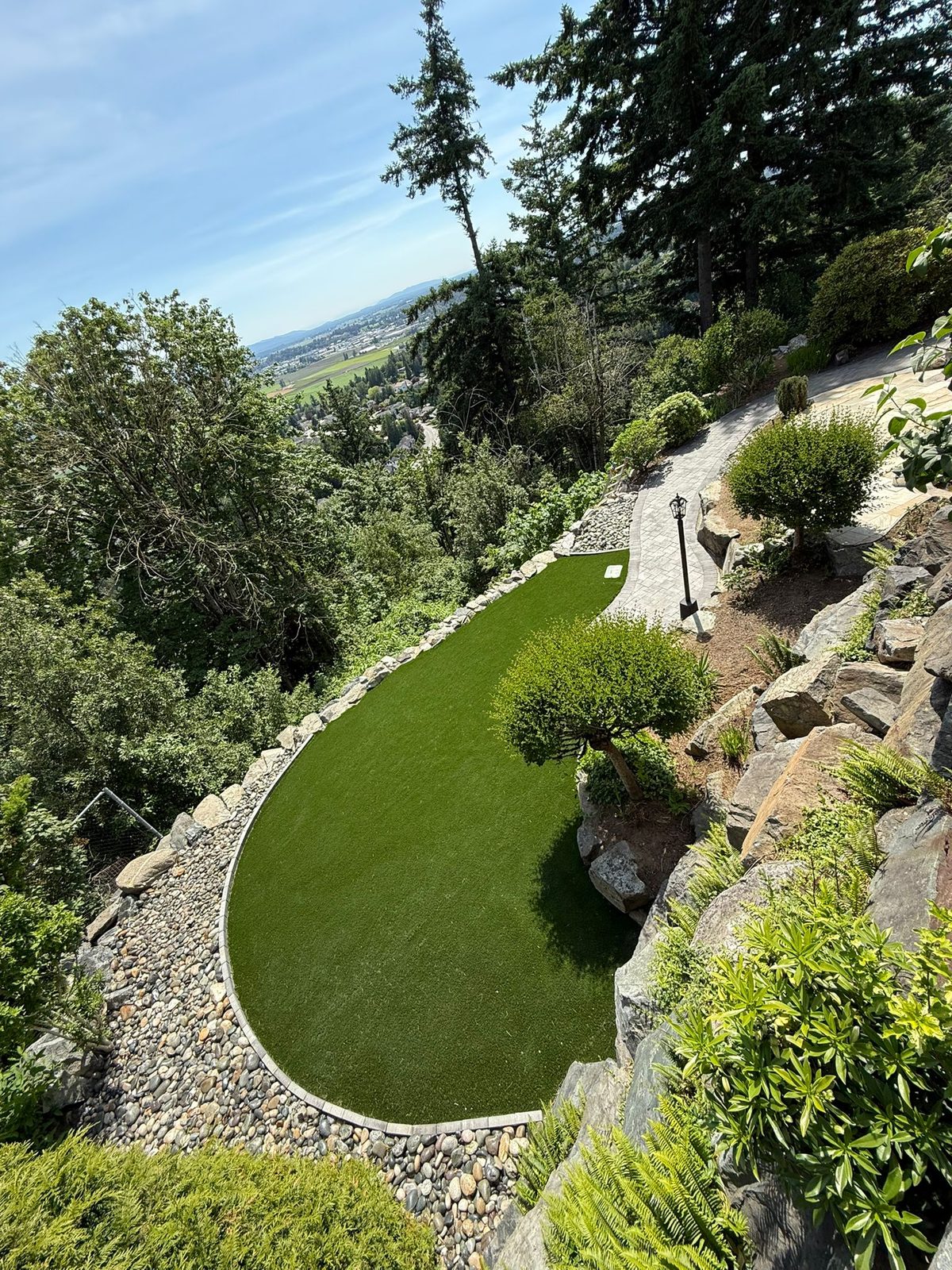
Even with a fully permeable base, we pitch the sub grade at a minimum of one to two percent away from foundations, fences, and neighbouring properties. This ensures that water moves laterally through the base rather than pooling in low spots. On larger installations, we sometimes incorporate a central spine with slopes falling to both sides, or direct water toward a catch basin or drainage swale at the perimeter.
Getting the slope right requires careful grading before any base material is placed. We use laser levels to confirm grade across the entire installation area. A few inches of incorrect pitch in a 600 square foot yard can mean the difference between a lawn that drains perfectly and one that holds water along a fence line every time it rains.
Pet Areas and Extra Drainage Capacity
Pet areas need drainage that goes beyond standard residential requirements. Dog urine is concentrated and acidic, and it needs to flush through the turf and base quickly rather than sitting in the infill. We build pet area bases with additional depth, higher drain rock content, and in many Abbotsford installations, a dedicated perimeter drain line that ties into the property's existing stormwater system. This ensures that urine and rinse water leave the area entirely rather than saturating the base layer.
Sources & References
- Synthetic Turf Council — Drainage and Base Construction — Synthetic Turf Council
- Environment and Climate Change Canada — Abbotsford Precipitation Records — Government of Canada
- Metro Vancouver — Stormwater Management — Metro Vancouver