
Why Drainage Is Non Negotiable in the Fraser Valley
The Fraser Valley receives over 1,500 millimetres of rain per year, with the heaviest months dumping 200 plus millimetres in November and December alone. Our soil is predominantly heavy clay, which means water does not percolate down through the ground the way it does in sandy or loamy regions. If you build a patio in Abbotsford without a drainage plan, you will have standing water on the surface, saturated base material underneath, and accelerated deterioration of both the pavers and the base. Every patio we build includes drainage engineering as a core part of the design, not an afterthought.
Surface Slope: The Foundation of Patio Drainage
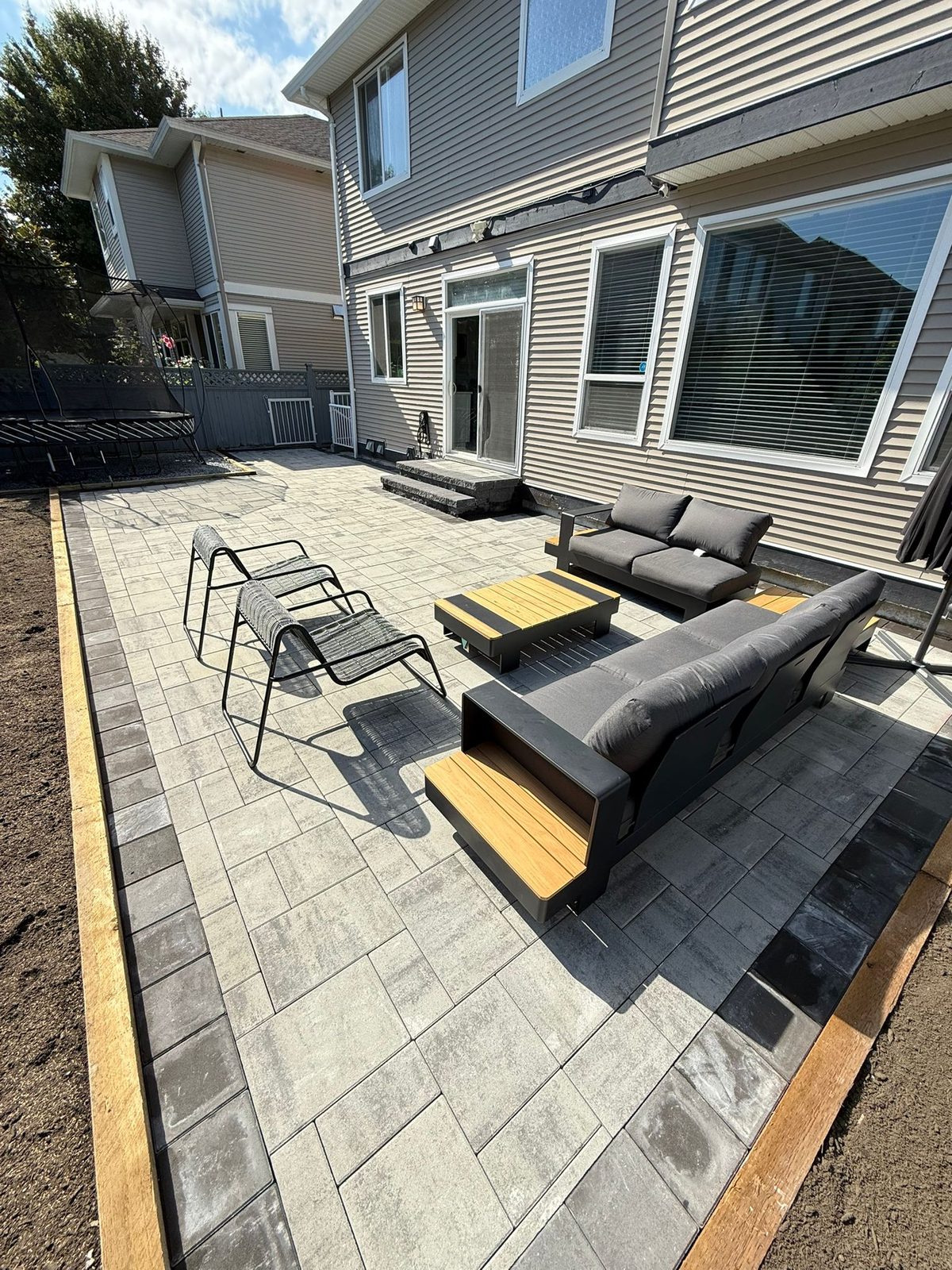
Every patio needs a minimum slope of 2 percent, which works out to roughly a quarter inch of drop per foot of patio length. The slope should always direct water away from the house foundation and toward a drainage outlet, whether that is a lawn, garden bed, or catch basin. On a 16 foot deep patio, a 2 percent slope means the far edge sits about 4 inches lower than the edge against the house. This slope is subtle enough that you do not feel it underfoot and furniture sits level, but it moves water efficiently across the surface.
We grade the base material to establish the slope before laying pavers, then verify the finished surface with a string level. Getting this right during construction is straightforward. Trying to fix drainage on an existing patio that was built flat is a much larger and more expensive project.
French Drains and Catch Basins
On properties where the patio sits lower than the surrounding yard, surface slope alone may not be enough. French drains installed along the patio perimeter collect subsurface water and channel it to a discharge point. A French drain is a perforated pipe wrapped in filter fabric and surrounded by drainage rock, installed in a trench alongside or beneath the patio edge. Catch basins are surface level collection points with a grate that captures runoff and pipes it underground to a storm drain or daylight outlet.
In Abbotsford, we install French drains on roughly half of our patio projects, especially on lots that slope toward the house or have clay soil that creates a bathtub effect around the patio perimeter. The cost adds 15 to 30 dollars per linear foot but prevents thousands of dollars in water damage over the life of the patio.
Permeable Pavers for Maximum Water Management
Permeable paver systems allow rainwater to pass directly through the paver surface and into a specially engineered aggregate base that stores and slowly releases water into the ground. These systems use pavers with widened joints or built in spacers that create channels for water infiltration. The base beneath uses open graded aggregate with large voids instead of compacted road base.
Permeable systems are ideal for Abbotsford properties with limited options for surface drainage or strict stormwater management requirements. They cost more than standard installations, typically 35 to 65 dollars per square foot, but they eliminate the need for separate French drains and catch basins in many cases. They also reduce runoff, which some municipalities in the Fraser Valley are increasingly incentivizing through stormwater credits.
Sources & References
- ICPI Permeable Interlocking Concrete Pavement (PICP) Technical Resources — Interlocking Concrete Pavement Institute
- Environment Canada Climate Normals — Abbotsford A — Environment and Climate Change Canada
- City of Abbotsford — Stormwater Management — City of Abbotsford
- BC Building Code — Government of British Columbia