
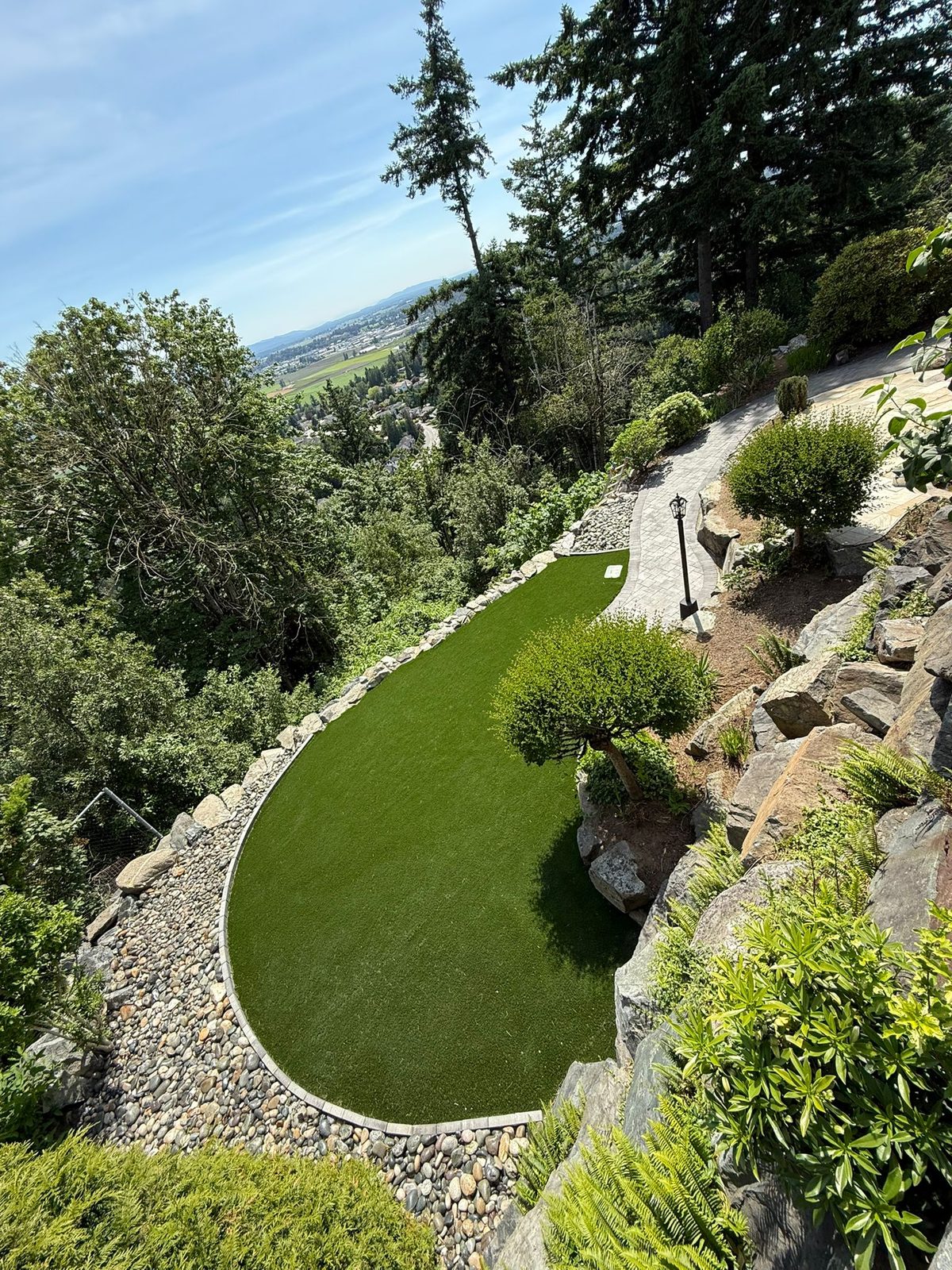
Why Putting Green Turf Is Different from Lawn Turf
Putting green turf is a completely different product from the turf we install on residential lawns. Lawn turf is typically polyethylene with a pile height of 35mm to 65mm, designed to look and feel like natural grass. Putting green turf is nylon with a pile height of 10mm to 15mm, designed to replicate the speed and consistency of a real green. Nylon is denser, more durable, and provides the smooth, fast roll that golfers expect.
The short pile height means putting green turf is also more demanding in terms of base preparation. Every imperfection in the sub base shows through in the ball roll. A small bump or dip that you would never notice on a lawn becomes immediately obvious when a golf ball rolls across it. This is why putting green installations require a higher level of precision than standard turf projects.
Base Construction for a True Roll
We build putting green bases using the same layered approach as our lawn installations, but with tighter tolerances. The compacted road base is leveled to within a quarter inch across the entire surface, then topped with a layer of crusher dust that we fine grade by hand. In Abbotsford, where clay soil shifts with seasonal moisture changes, we also install a geotextile separation layer to prevent clay migration into the base.
For greens with designed breaks and undulations, we shape the base layer to create the contours. The turf conforms to whatever shape the base provides, so the topography is built into the foundation rather than into the turf itself. This takes time and craftsmanship, but it is what separates a putting green that plays well from one that is just a flat patch of short turf.
Designing Breaks and Slope
A flat putting green is boring. The fun of a backyard green comes from subtle breaks and undulations that challenge your putting skills. We work with each homeowner to design contours that match their skill level and the available space. A beginner might want gentle, predictable slopes. An experienced golfer might want more aggressive breaks that simulate real course conditions.
The maximum slope we recommend for residential greens is about three percent. Anything steeper makes the ball roll too fast and reduces the number of usable pin positions. We typically include two or three cup locations on greens of 200 square feet or more, positioned so that each pin offers a different putting challenge.
Size Options and Cost
Backyard putting greens in Abbotsford range from compact 100 square foot practice areas to full 500 square foot greens with multiple pins, chipping areas, and fringe turf. A basic 150 square foot putting green with one cup location and a simple perimeter border typically starts around $3,000 to $4,000 installed. Larger, more complex greens with multiple contours, cup positions, and integrated chipping zones can run $8,000 to $15,000 depending on the design.
Many of our clients start with a modest green and expand later. Because the base construction is the expensive part, we can plan the initial base to accommodate a future expansion, which saves money down the road.
| Spec | Putting green turf | Residential lawn turf |
|---|---|---|
| Fibre material | Nylon | Polyethylene |
| Pile height | 10mm to 15mm | 35mm to 65mm |
| Base tolerance | Within 1/4 inch | Within 1/2 inch |
| Infill | Silica sand (speed tuned) | Silica sand or Envirofill |
| Typical lifespan | 15 to 20 years | 15 to 20 years |
Sources & References
- SYNLawn — Putting Green Turf Systems — SYNLawn
- Synthetic Turf Council — Golf Application Guidelines — Synthetic Turf Council
- USGA — Green Speed and Stimpmeter Guidelines — United States Golf Association